01 · Roots · Connection
Coaching Parents
Family Camp
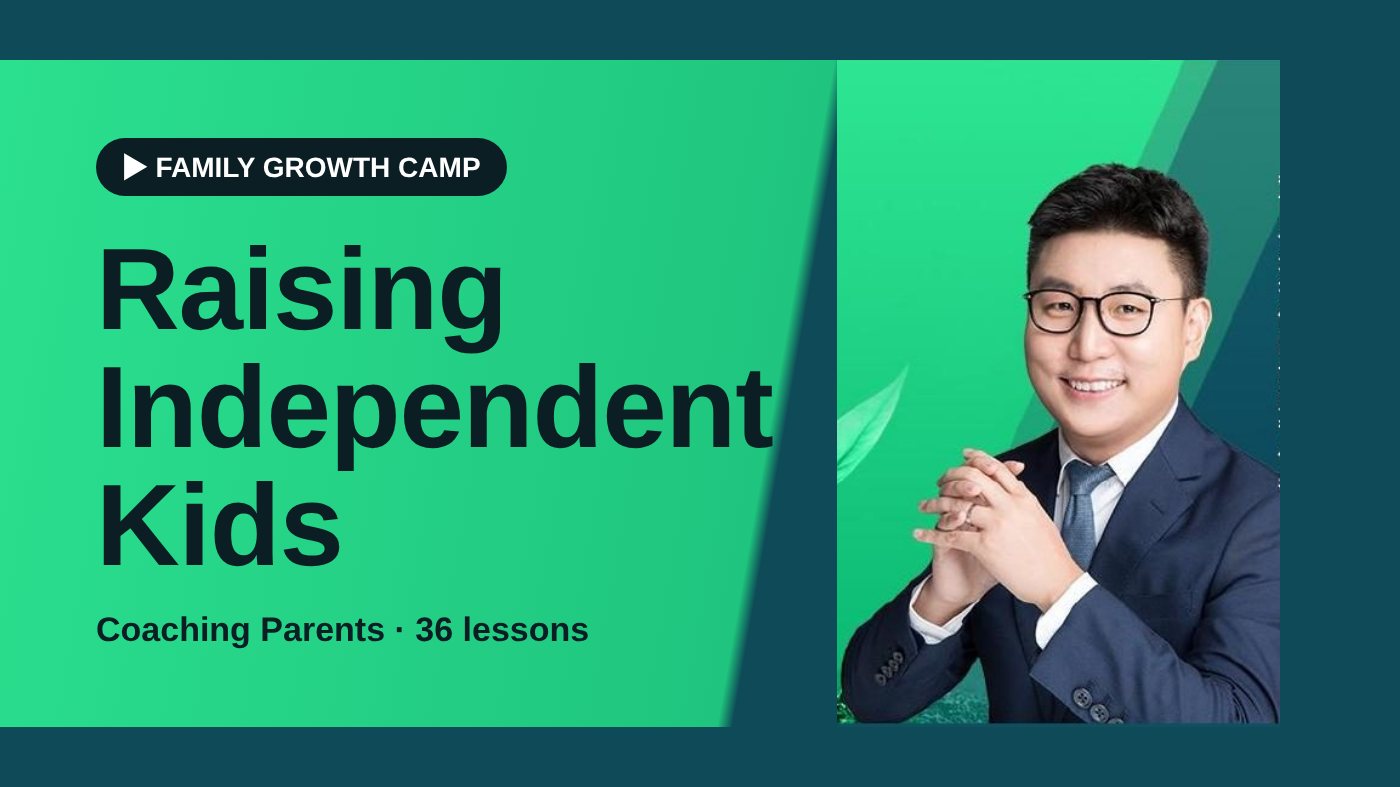
Raising independent kids. Talk with your child like a coach: less nagging, more questions. Four modules build independent thinking, choosing, living and planning; the fifth is for parents.
01 / Why
You'll recognise
these moments.
Often the issue is neither the child nor the effort parents make. It is the way the conversation goes.
Homework needs constant reminders
Said a hundred times, still put off. The more we push, the more passive they become.
Talks turn into arguments
You mean well and it still ends badly. When the relationship tightens, so does learning.
No mind of their own
Waiting for adults to decide everything, lost without them.
Parents want to grow too
Wanting to be better parents while looking after work and marriage too.
A coach doesn't hand over answers; a coach draws them out. One good question moves a child further than ten reminders.
02 / What it is
From managing children
to growing alongside them.
03 / Syllabus
5 modules,
36 lessons.
Each lesson answers a question parents ask most. 1,500+ minutes of practical material, with long-term access.
Thinking for themselves
Setting goals, asking questions, judging information
- 01How do children find a real sense of purpose?Goals
- 02How can children master the Feynman method?Effective study
- 03How can a child give a great self-introduction in three minutes?Knowing yourself
- 04How do children understand why they study?Why we learn
- 05How can children spot fake news?Media literacy
- 06How do children learn to find information?Research skills
- 07How do we teach children to ask good questions?Asking questions
- 08How can reading ease the teenage years?*Adolescence
Choosing for themselves
From learning style to friends and books, making their own choices
- 09How do children get past indecision?Making choices
- 10How do we find a child's learning style?Learning style
- 11What kind of play and rest suits each child?Play & rest
- 12How can children choose the right books?*Choosing books
- 13How do children choose good friends?Friendships
- 14How do children become self-motivated?Self-motivation
- 15How do we build rules and habits?Rules & habits
- 16How do we create family values together?Family values
Living independently
Self-care, grit and teamwork that build confidence
- 17How can children understand what parents carry?Understanding parents
- 18How do we build everyday life skills early?Life skills
- 19How do we build grit and character?Resilience
- 20How do children develop an apprentice mindset?Apprentice mindset
- 21How do children learn to work in a team?Teamwork
- 22How do children move from self-doubt to confidence?Confidence
- 23How can a mock start-up teach children to steer their own lives?Enterprise
- 24How can biographies inspire children?*Biographies
Planning their own path
Early planning for learning, strengths, careers and money
- 25How do we find the right way for a child to learn?Ways of learning
- 26How do we introduce careers at each age?Career awareness
- 27How can hobbies grow a child's strengths?Strengths
- 28How do children learn to plan their money?Money planning
- 29Why should children understand investing early?Investing
- 30How do we plan ahead with a secondary-school child?Life design
Parents growing too
The last module is for parents themselves
- 31How can mothers grow through reading?*Growth for mothers
- 32How can each parent be a role model?Role models
- 33How can playful thinking improve family relationships?Connection
- 34How do marriage and personal growth shape each other?Marriage
- 35How should we rethink work and side projects?Work & side projects
- 36How can family and career find a better balance?Family & career
* Four marked lessons are taught by guest author Zhou Lu. Each lesson runs about 40 minutes.
04 / What changes
Afterwards,
what's different at home?
Setting goals, asking questions, judging information
From books to friends to study style, they decide
Self-care, grit and teamwork build confidence
Parents keep learning and lead by example
05 / Who it is for
Made for
these families
- Children aged 3–15; parents who want less nagging and more trust
- Family conversations that keep getting stuck
- Parents who want more independent, confident children
- Parents who want to keep growing themselves
06 / Mentors
Who leads it

Hua Zhang
Lead mentorFounder of YouthMBA and the AI Future School Project; Senior Visiting Scholar at NUS. Authorised in 2014 by the founder of the Stanford d.school to teach design thinking. Author of The World Is Our Classroom and Relearning How to Learn.

Zhou Lu
Guest lecturerYouth reading education specialist and author of a bestselling book on raising children through reading. A former senior journalist, she has served as editor-in-chief of Youshu Kids and vice-president of CITIC Academy. She teaches four reading-themed lessons in this camp.
07 / Join
One course,
a lifetime of use.
lessons
1,500+ minutes of practice
Live Q&A
Priority in live sessions
live replays
Past live shows, all open
Long-term
Unlimited replays
- 36 lessons, long-term access
- Priority one-to-one Q&A
- 1,000+ past live replays
Enrolment and offers are announced in our live sessions
08 / FAQ
You may be wondering
What ages is it for?
The course is for parents of children aged 3–15; the planning module is especially useful for secondary-school families.
How does it work? Are there fixed times?
All lessons are online video with long-term access, so families learn at their own pace.
Where do I sign up? Are there offers?
Enrolment runs through our founder's live channel on WeChat, which hosts an education show every morning with occasional offers.
Is there support afterwards?
Yes. Participants get priority in live Q&A sessions.
Next: Feynman Learning
Four camps, roots to leaves; each can be joined on its own.